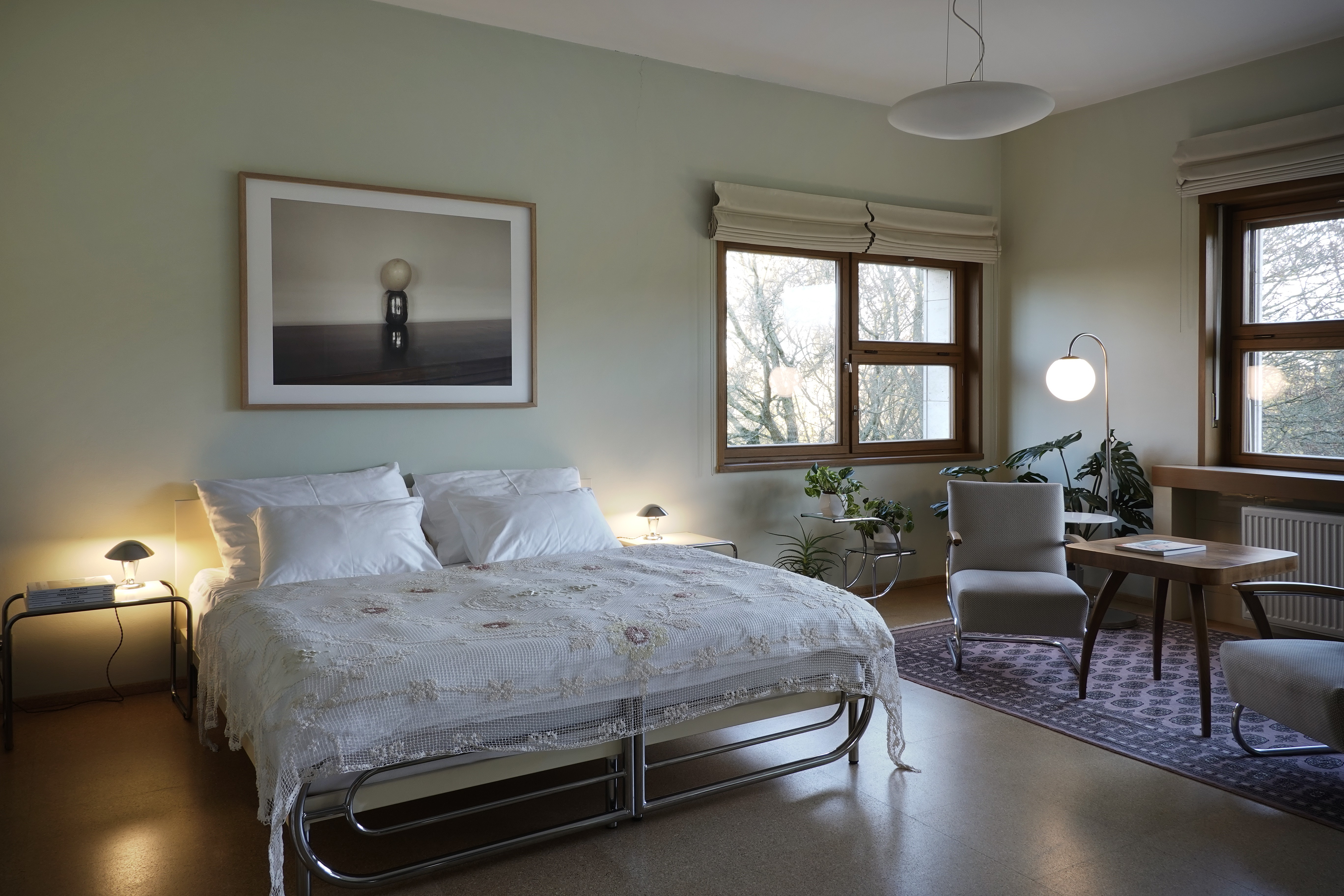
Experiential accommodation
Experience the villa differently than just as a visitor. Wake up in an iconic space that slows time, cultivates the mind, and offers peace of mind not normally found in the city.

The impressive villa was dreamed up by the manufacturer and benefactor Josef Volman in a large park above the romantic landscape of the Elbe River in Čelákovice, 20 km east of Prague. One of the most beautiful and expensive residences of the First Republic was designed for him in 1938-1939 by young avant-garde architects Karel Janů and Jiří Štursa. The magnificent grounds of the villa are an excellent example of modern housing of the interwar period, the best of Czech functionalism and architecture as well as the ideas of Le Corbusier, who was a great inspiration and role model for the architects.
Leading creators of the Czech interwar avant-garde, left-leaning Jiří Štursa (*1910 — †1995) and Karel Janů (*1910— †1995), were already actively involved in events in architectural circles during their studies at CTU. In 1931 he and Jiří Voženílek founded the Working Architectural Group PAS. At the same time, Teige's pupils, active followers of a scientific approach to architecture, were great admirers of Le Corbusier.
In the second half of the 1930s, they expanded the rational scientific approach to include the demands of the human soul. In addition to the scientific, they also admitted the psychological function of architecture, to which they were helped by Freud's psychoanalysis and surrealism. Gradually, emotional and artistic elements began to be promoted in the designs. The highlight of this period is precisely Volman's Villa (1938-1939), the most famous joint realization of the tandem of architects. A monumental structure that architects did not subscribe to after the communist coup.
Professor Jiří Štursa taught at the Faculty of Architecture since 1948, where he influenced the next generation of architects and theorists through his many years of work. Together with his wife Vlasta Štursova, he created a plinth with staircases and terraces for the Stalin monument by Otakar Švec in the 1950s. Professor Karel Janů worked at the Faculty of Civil Engineering and continuously devoted himself to the concept of industrialization of the construction industry, which he led to his invention of the so-called residential core.
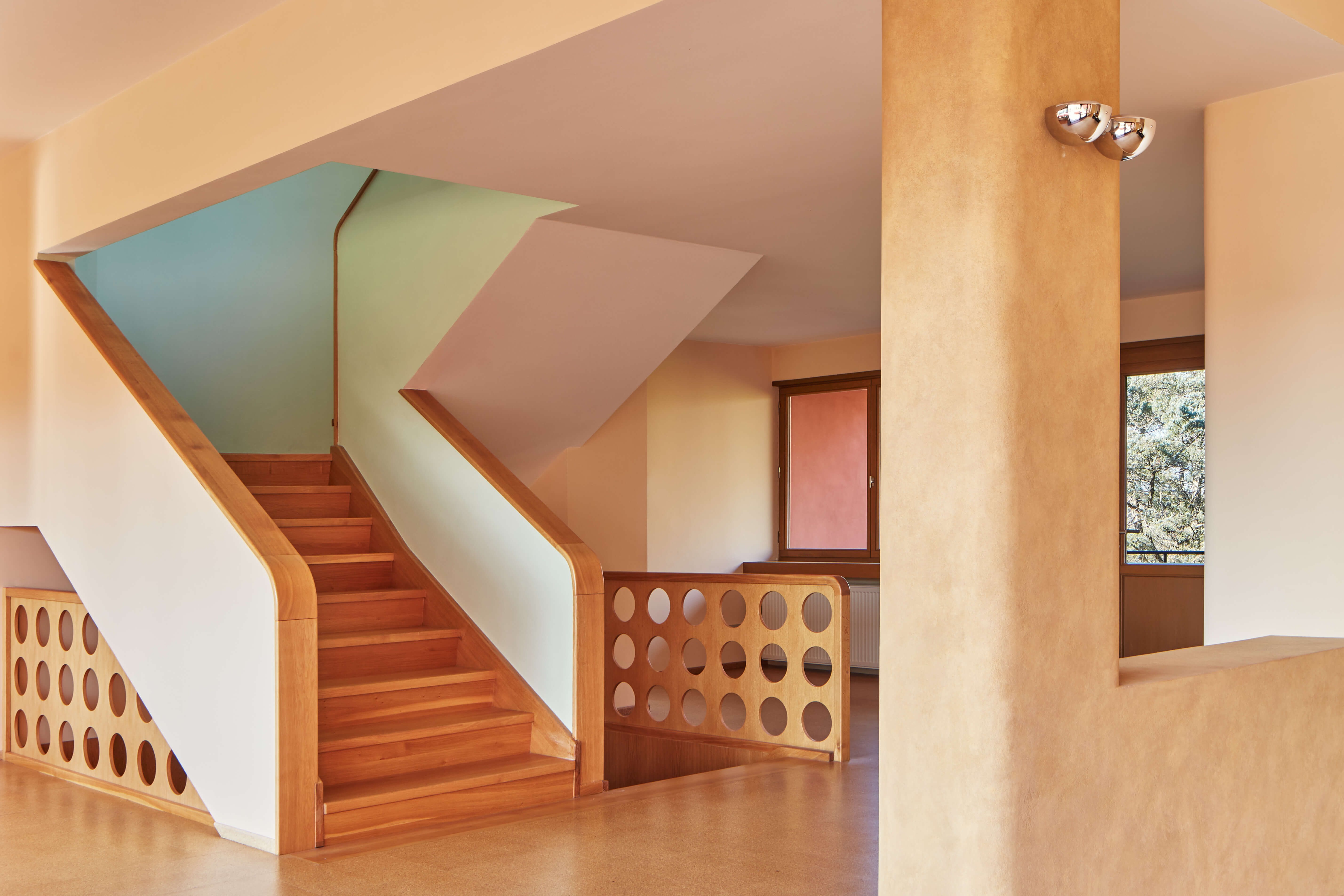
Volman's Villa is a unique realisation of interwar modernity and a deliberate homage by the authors to Le Corbusier. It represents the outcome of the ideas of modern architecture, and it is all the more valuable that we find in it a synthesis of different currents of European modernity. It shows how its creators knew very well the current European trends and were able to process them into an exceptional construction. With a unique artistic concept and the use of expressive color, we place the villa in the current of emotional functionalism.
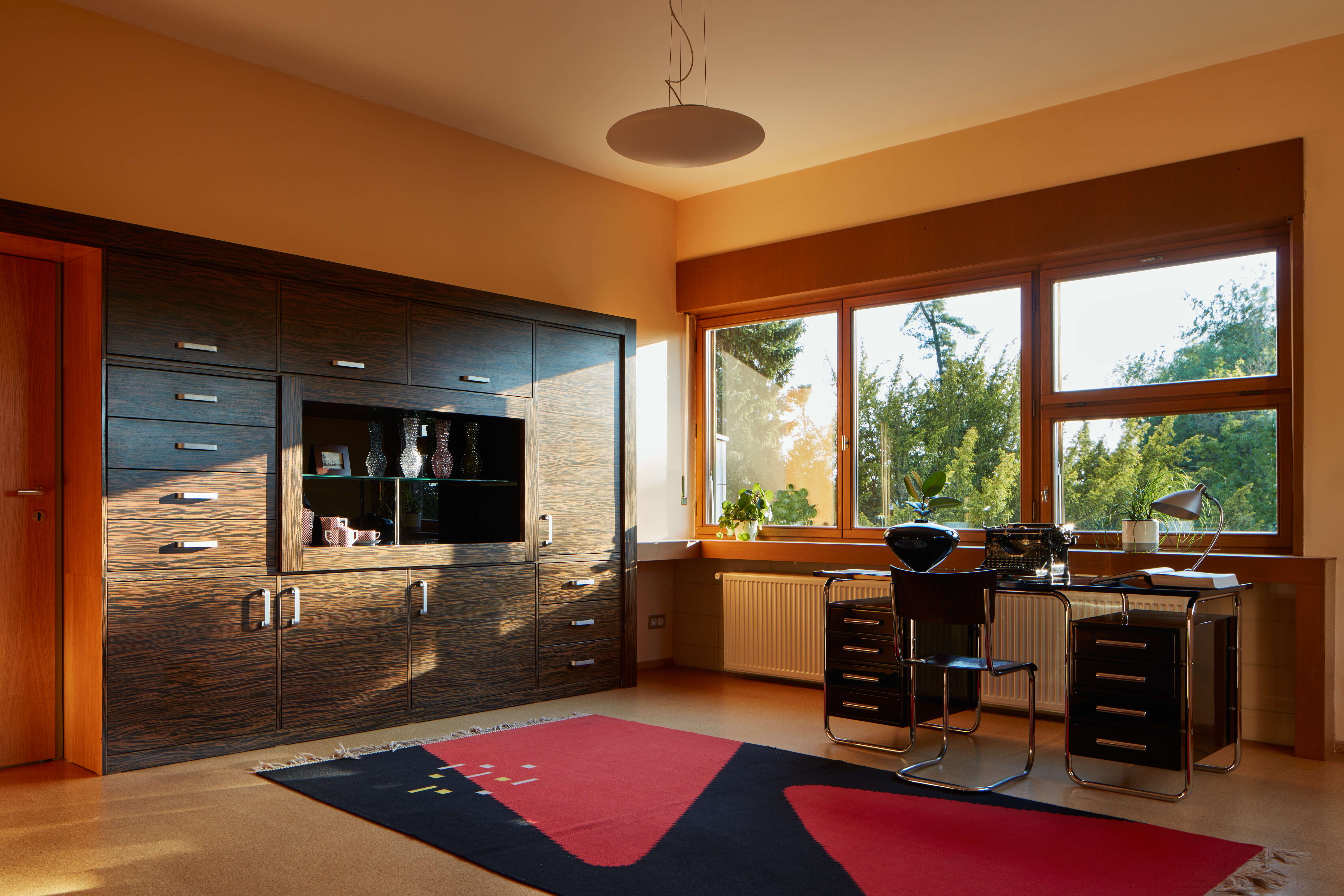
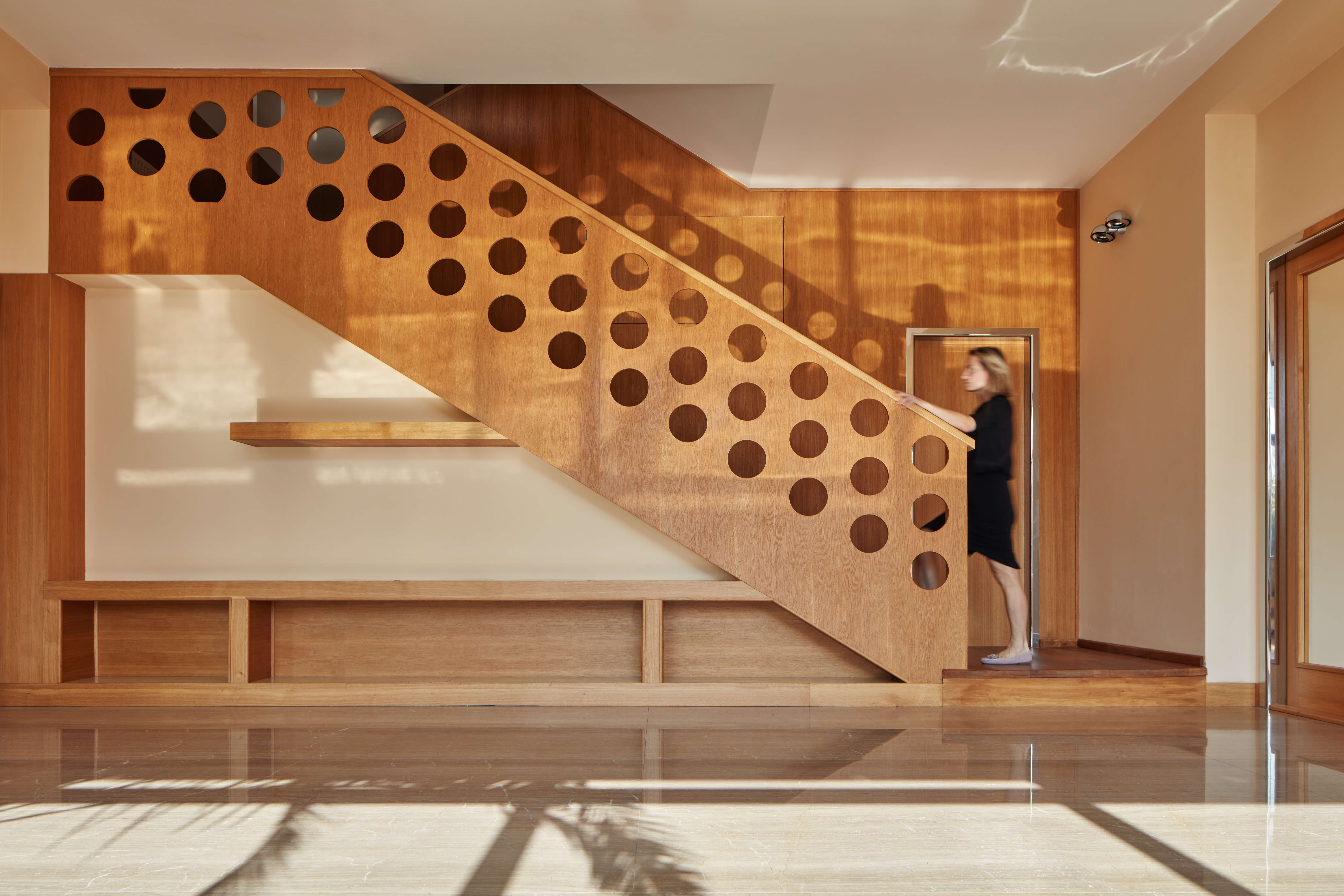

The generous structure may resemble an overseas steamer monumentally anchored on the horizon of a slope above the Elbe floodplain. Sharp lines alternate curved walls and organic details. Elegant, smooth surfaces contrast with traditional stone masonry and travertine cladding. The interior is made up of a rich mosaic of luxurious materials, in the villa you will find several types of marble, chrome details and exotic woods. The cantilevered terraces evoke the captain's bridges and at different levels functionally and aesthetically connect the house with the surrounding park.
It offers different but always breathtaking views of the surrounding landscape and park at any time of the year. The roof terrace with windbreaks and a flower bed or the circular stone roundabout of the main entrance are other original features that make Volman's villa easy to remember.
Josef Volman (1883 — 1943), founder of the machine tool factory in Čelákovice was a successful entrepreneur of the First Republic of Czechoslovakia. He was able to transfer his success to the flourishing of the whole region and contributed significantly to the development and growth of Čelákovice. The progressive-minded Volman settled in Čelákovice in 1910 after returning from a study stay in the USA.
After the First World War his plant grew rapidly, with modern machine tools he gradually established himself not only in Czechoslovakia but also on the world engineering market. Volman's company was one of the world's leading manufacturers and exporters of machine tools, trading in more than 30 countries. Unfortunately, he died prematurely in 1943 and the management of the plant was taken over by his daughter Ludmila and her husband Jiří Růzko.
Josef Volman was also distinguished by his great sense of social responsibility. All his life he devoted energy and finance to a number of social projects and providing for his employees. He dealt intensively with the issue of employee housing, had a colony of tenements built, built the Volman Sports Club, and generously promoted social life in the county. During World War II, he supported both domestic and foreign resistance financially and materially.
Volman's decision to build a luxurious modern villa as part of the entire complex on the northwestern outskirts of Čelákovice dates back to 1937. The construction itself took place in 1938-1939, when he and his daughter Ludmila moved into the villa. After the forced departure of the family after the communist coup in 1948, the entire area was acquired by the national enterprise TOS Čelákovice. The building was used for various celebrations, cultural and social events, then from 1952 to 1990 as a kindergarten for children of employees of the national enterprise.
Already in 1979, the entire site was inscribed in the Central List of Immovable Cultural Monuments, between 1980 and 1982 an overhaul of the villa was carried out, which proved counterproductive in terms of preserving the original qualities of the interiors. After 1990, the house was not used as a result of restitution proceedings, its devastation to the level of disrepair, with the threat of demolishing the north wing. All equipment, including installations and fittings, disappeared from the building. The cultural monument of world importance paid off with looting and vandalism.
In 1996, a group of Čelákovice businessmen bought the villa, who became an investor in an extraordinary renovation aimed at bringing it to its original state. A follower of Volman's engineering tradition, he was instrumental in restoring the original manufacturer's residence and presenting its extraordinary architectural qualities. The reconstruction project was entrusted to TAK Architects and the team led by architect Mark Tichý started a difficult stage of reconstruction lasting until 2018.
This achievement was also awarded the Jury Prize for the sensitive reconstruction of the devastated monument in the 2016 Building of the Year competition. In 2020, the monograph “Volmanova vila - jewel of interwar architecture” was published (authors: Jolana Tothová, Marek Tichý, Radomíra Sedláková, Magdalena Kurfürstová, nakl. Argo), which is evidence of more than 15 years of effort associated with the restoration and renovation of the villa.
In September 2022, Vila Volman joined the prestigious global network ICONIC HOUSES and opened the tour circuit to visitors.
Villa Volman is a fresh member of the global network of Iconic Houses, a prestigious international network connecting architecturally important houses and studios from the 20th century, which are also open to the public. It ranks among the world's modernist icons and represents the Czech Republic on the map of modern architecture.
iconichouses.org